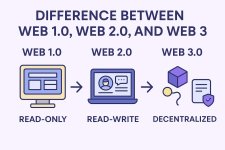

softfix
Member
The internet has evolved through multiple stages, each offering new possibilities, better user experiences, and smarter technologies. These stages are commonly known as Web Versions – Web 1.0, Web 2.0, and Web 3.0. Understanding these versions helps developers, businesses, and users identify how today’s digital world was shaped.
In this blog by Softfix, we will break down the major differences between Web 1 vs Web 2 vs Web 3, with easy explanations, real-life examples, and a comparison of how the internet moved from static pages to intelligent, decentralized applications.
What is Web 1.0? (The First Generation of the Internet)
Web 1.0 was the earliest version of the internet, active from the early 1990s to early 2000s. It was known as the read-only web, where users could only view information but not interact with it.Key Features of Web 1.0
- Static HTML pages
- No login systems
- Limited user interaction
- Information was delivered in one direction
- Text-heavy websites
Web 1.0 Examples / Example Web 1.0
Here are some simple web 1.0 examples:- Early Yahoo pages
- Read-only news portals
- First-generation business websites
- Britannica Online
- Static educational resources
What is Web 2.0? (The Interactive and Social Web)
Web 2.0 emerged in the early 2000s as the read-write web. It introduced user participation, dynamic content, and interactive platforms. This is the internet most people use today.Key Features of Web 2.0
- User-generated content
- Social networking
- Mobile apps
- Dynamic webpages
- Cloud technologies
- E-commerce and online payments
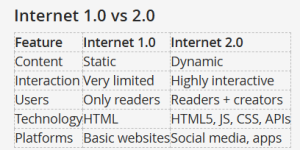
Web 2.0 gave rise to platforms like Facebook, YouTube, Twitter, Pinterest, and interactive portals.
What is Web 3.0? (The Intelligent & Decentralized Web)
Web 3.0 represents the next level of the internet, also known as the semantic web or decentralized web. It uses AI, blockchain, and machine learning to deliver smarter and more secure experiences.Key Features of Web 3.0
- Decentralized data storage
- Blockchain-based applications
- Semantic search
- Artificial intelligence
- Interconnected smart devices
- Enhanced privacy and security
Web 1.0 2.0 3.0 Examples
Let’s understand all three with examples:
Web 1.0 vs Web 2.0 Differences (Clear & Simple)
Here are the major web 1.0 vs web 2.0 differences: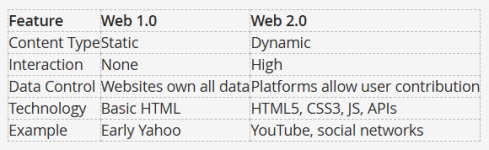
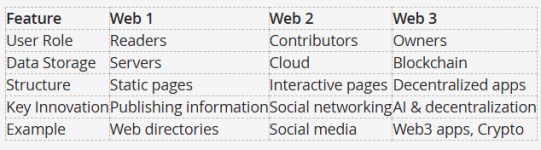
Web 1 vs Web 2 vs Web 3 – Complete Comparison
Web GIS 2.0 Portal – A Modern Example of Web Evolution
A Web GIS 2.0 portal is a perfect example of modern web technology. It allows users to:- Analyze maps
- Share geospatial data
- Interact with real-time analytics
Conclusion: The Internet is Evolving Faster Than Ever
The journey from Web 1.0 to Web 2.0 and Web 3.0 shows how the internet has become more interactive, intelligent, and decentralized. From static pages to smart platforms, each stage of evolution has transformed how we communicate, browse, work, and do business.At Softfix, we continue to stay ahead of digital trends and help businesses adapt to the next generation of the internet.